Series: Get to Know Our Experts | IMPACTsci
Theme: Autism, Education and Development
1. Pedro, please introduce yourself in your own words. Who are you and what brought you to this field?
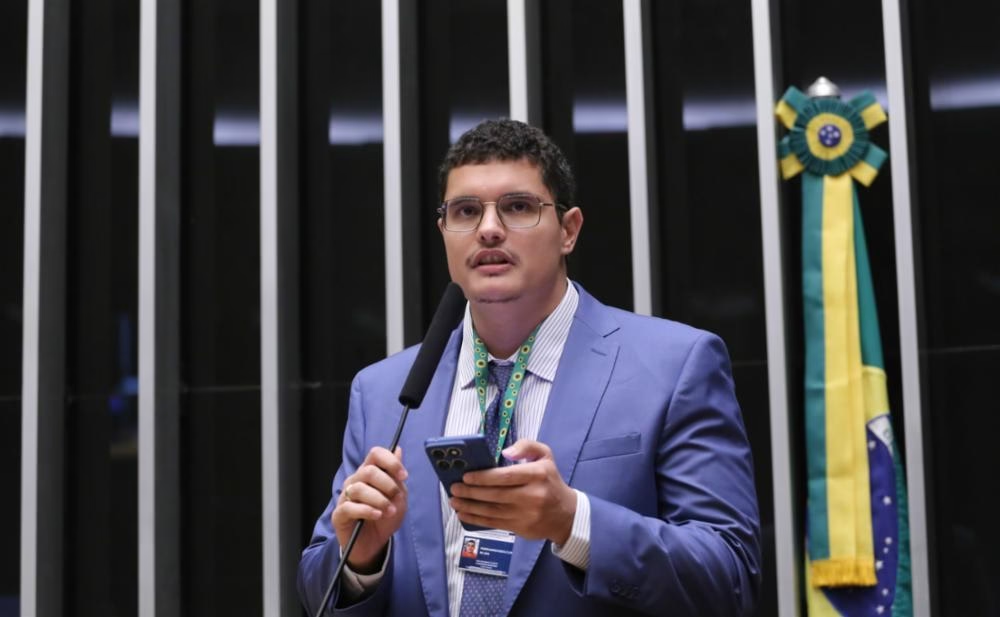
I am Pedro Lucas, an autistic person, teacher and researcher in the field of educational psychology for special needs, focusing on inclusive education. My work centres on the relationship between autism, education and development. My journey actually began with my own experience as a student.
During my childhood and adolescence, I faced many barriers. There were moments and people that ultimately hindered my development. However, throughout my path, I also encountered teachers, especially pedagogues, who were absolutely pivotal in my life. They believed in my potential to participate and thrive as an autistic student, often believing in me far more than I could within myself at the time.
These teachers created concrete conditions for my growth. They worked with alternative communication, used plain language, structured pedagogical support, suggested shared reading sessions, and helped me interpret the world and navigate social situations. In other words, they acted directly in building my development opportunities.
Looking back today, I can frame this experience within a very clear theoretical framework: Lev Vygotsky and the Historical-Cultural Theory. Even before formally knowing this theory, I was deeply impacted by educational practices that stem from this exact principle: that human development is socially and culturally mediated, and that well-organised teaching can drive development forward.
This memory stayed with me and shaped who I am. It is what brought me to this field. I wanted to understand, theorise and give back to the world what was, in some way, decisive in my own life.
2. What does it mean to you to be both an Autistic Person and a specialist in inclusive education? How does this dual perspective change the way you work?
Being an autistic person, an inclusive education specialist and a researcher into the relationship between autism, education and development simultaneously gives me a distinct epistemological standpoint within the field.
Throughout my journey, especially in childhood and adolescence, I went through times when I had significant support needs. This lived experience stayed with me when I entered university and became a researcher. It became an active element in the way I produce knowledge.
Today, there are several autistic researchers contributing to the field, which is extremely important. I am not alone, and that strengthens the discipline. What sets us apart, generally speaking, is the ability to produce knowledge from a first-person perspective.
In my case, experiencing autism allows me to look at educational processes as a lived experience, alongside being an object of study. This deeply changes the way I work. When I think about pedagogical mediation, language, environmental design or participation, I recognise how these dimensions operate in practice, in the body, in teaching relationships, and in daily school life.
If we imagine two specialists delivering training on autism, one with a solid theoretical background and the other being myself, the difference lies in how that knowledge is formed.
I bring the bridge between theory and lived experience. I bring the ability to challenge abstract readings with the actual complexity of navigating school life as an autistic person. I also bring a much finer attention to support systems, to the details of relationships, to language, and to the expectations placed upon the student.
My experience as an autistic student refines the questions I ask, the paths I choose in research, and the conclusions I reach as a teacher and researcher.
This has a direct impact on my work: I tend to design practices and training modules that stem from development potentials, and from the right conditions for support, participation and access.
Ultimately, this dual perspective means I cannot separate knowledge from experience. It is precisely this connection that guides how I teach, research and act within inclusive education.

3. What kind of people and contexts do you work with on a daily basis?
Currently, my work focuses primarily on specialised educational support for autistic children and adolescents. Direct contact with students has gradually decreased as the demand for pedagogical supervision has grown.
Today, a significant part of my role involves guiding professionals who work directly with these students: specialised education teachers, inclusive education staff, mainstream classroom teachers, therapeutic support workers, and families. In this context, I provide supervision where I monitor and contribute to the practice of these professionals, combining my experience as an autistic person, researcher and specialised teacher.
Another important area of my work is teacher training. I work both in initial teacher training, within degree and teaching qualification courses, and in continuing professional development, through specialisations and advanced courses. I also aim to supervise Master’s and PhD students in the future, expanding my contribution to the academic training of new researchers.
Additionally, at the University of Brasília, I coordinate the educational division of the Autism and Neurodiversity Hub. In this role, I supervise Pedagogy students, monitoring their work in specialised educational support for autistic students within the university itself.
These different strands, pedagogical supervision, teacher training and university work, make up the core of my current work, always framed within inclusive education and a commitment to more qualified, contextualised practices.
4. You have done a lot of work around assistive technology and educational accessibility. Can you give a concrete example of how this changes a neurodivergent person’s life?
When we talk about assistive technology and educational accessibility, we are fundamentally talking about creating real conditions for autistic students to participate, because development happens through participation.
A very concrete example comes from the work I have been doing with sensory adjustments and augmentative and alternative communication (AAC) in the classroom. In many situations, we find autistic students who cannot follow the school routine because the environment is overwhelmingly stimulating, or because no support is offered to help them process and interpret sensory information and situations.
In one of these settings, we introduced two main changes. First, we organised the environment based on Universal Design principles: reducing sensory overload, ensuring routine predictability, and creating quiet spaces for all students. This immediately reduced stress and anxiety levels and, because it was available to everyone in the class, it reduced the stigma around the autistic students.
The most striking transformation came with the introduction of augmentative and alternative communication, using pictograms and visual aids. This student, who previously faced major barriers in understanding what was expected of him and expressing himself, was suddenly able to anticipate activities, make choices and communicate his needs and wishes, broadening and strengthening his sense of agency.
What changed was the way he participated. He was no longer on the sidelines of activities and began to engage more actively in classroom tasks. From there, we started to see a broadening and improvement in his learning process, social relationships, and, of course, his development.
This type of resource makes access to meaning possible. It is precisely this connection to meaning that sits at the heart of social participation and human development.
Furthermore, when we think about these strategies through Universal Design, they stop being something “tailored” for a specific student and start improving the experience of the whole class. In other words, while ensuring accessibility, we also build more inclusive and powerful educational settings for everyone.
5. In your work with teachers and educators, what is the most common mistake you still see in how autism is handled in schools and training courses?
One of the issues I notice most in teacher training, especially in professional development courses, is viewing autism as a deviation from a supposed normality. This is perhaps the most recurrent mistake: reducing autism to what is deemed inappropriate, deviant or wrong behaviour, analysing the autistic person’s development based on an extremely fragile and limited element, which is solely observed behaviour.
Often, this analysis is driven by a historically and culturally constructed idea of what is “normal”, “correct” or “appropriate”, taking this norm as an absolute benchmark to interpret the autistic student. The problem is that when a teacher operates from this mindset, they fail to understand the student in their uniqueness and their concrete possibilities for participation and growth.
This approach becomes a barrier to education in itself. It prevents the teacher and student from building resources, strategies and social development pathways together during the learning process. Instead of encouraging participation, the school operates on trying to fix or normalise the student, which deeply limits their opportunities for learning, interaction and belonging.
6. What does Affirmative Neurodiversity mean to you? What does it look like in practice, and what is it NOT?
To me, affirmative neurodiversity means understanding diversity in human and social development, and valuing this diversity as a strength for growth and a path toward full participation in community life. It means recognising that different ways of perceiving, feeling, communicating and relating to the world are not deviations from a norm, but legitimate expressions of the human experience.
In practice, an affirmative neurodiversity framework involves offering multiple pathways for participation, communication and expression. It means building accessible educational environments where autistic students can engage through their own ways of relating and developing, rather than being constantly forced to adapt to rigid, normative standards.
As a researcher connected to critical autism studies, I view affirmative neurodiversity as a core concept precisely because it fundamentally shifts the perspective of analysis and educational practice. It moves the focus away from a mindset based on control, compliance and obedience, which is highly prevalent in traditional autism practices, towards an approach committed to broadening, improving and making communication and participation accessible for autistic students within pedagogical settings.
In this sense, affirmative neurodiversity is not about using more modern language around autism while keeping the same old goals of normalisation. It is not about superficially adapting your discourse while still trying to correct behaviours, eliminate differences or manufacture a performance of “normality”. A truly affirmative practice requires transforming the actual conditions of participation, recognising the autistic student as an active participant in their education, not as someone who needs to be adjusted to fit normative expectations.
7. When you look at the market for training on autism and neurodiversity, what concerns you? What is missing?‘
When I look at the current market for training on autism and neurodiversity, one of my main concerns is the ongoing dominance of training programmes focused on control, conditioning and normalising autistic individuals. There is still a strong presence of approaches that reduce the autistic student to a set of supposedly deviant behaviours that need to be corrected or adjusted to fit what is deemed appropriate.
Many of these courses remain driven by an ableist mindset, where the primary goal is to produce compliance and obedience, rather than building real opportunities for participation, communication and development. Even when they use seemingly modern language around inclusion or neurodiversity, in practice they often maintain the same normative assumptions historically found in autism interventions.
Because of this, we need to broaden the presence of critical autism studies, historical-cultural theory and, crucially, approaches led by autistic people within teacher and professional training. These perspectives make it possible to understand autism through its rich possibilities for communication, expression, learning and community participation.
Additionally, I notice a lack of ongoing supervision and pedagogical guidance. A one-off training session has limited reach. Our society is deeply structured by ableist and normative views on social relations, and this flows into daily school life intensely. Therefore, we must build permanent spaces for reflection, active listening and supervision, ideally with the involvement of autistic professionals, researchers and scholars committed to critical and affirmative views on autism.
More than teaching techniques, what is missing is a shift in how we understand development, learning, participation and difference within schools.
8. What is the difference, in your view, between training delivered by neurodivergent individuals and training done by those who study the topic “from the outside”?
Before answering this directly, I think it is important to add a caveat: the fact that a training session is led by an autistic person does not, on its own, automatically guarantee a neuroaffirmative or critical perspective on autism. That individual also needs to have built an understanding aligned with critical autism studies, neurodiversity and historical-cultural perspectives on development. This is because some autistic individuals can also replicate approaches based on control, conditioning, normalisation and behavioural conversion.
That being said, there is a very significant difference when the training is delivered by an autistic person committed to critical and affirmative views. In this case, those participating are learning from someone who has lived the experience of autism and, crucially, the experience of school life as an autistic person.
In my case, for example, my school experiences as an autistic individual are highly present and vital memories in my current work as a researcher and teacher trainer. These experiences allow me to notice aspects of schooling that rarely show up in traditional or purely technical approaches to autism.
Therefore, the main difference lies in an understanding shaped by the actual experience of living with this condition in a society and in school systems structured around normative expectations. There is a dimension of experience, sensitivity and awareness of social and educational barriers that can hardly be fully grasped from the outside alone.
When this lived experience is combined with critical and neuroaffirmative frameworks, the training tends to shift the focus away from correcting behaviour towards building genuine opportunities for participation, communication, belonging and development.
9. What should organisations – companies, schools, institutions – demand when choosing a training provider in this field?
In my view, the most important thing is for schools, businesses and institutions to choose training providers that are truly committed to the well-being, participation and social development of autistic people, and guided by rigorous ethical and pedagogical frameworks, away from purely commercial interests.
Unfortunately, there is still a massive market for training that operates within a deeply ableist framework, replicating practices of control, normalisation and behavioural adaptation without any critical reflection on how these approaches impact the lives of autistic individuals. Because of this, institutions must question the ethical, scientific and pedagogical assumptions underpinning any training.
An important question to ask would be: is this training committed to expanding the participation, autonomy, communication and well-being of autistic people, or is it focused solely on behavioural adjustment and compliance? Another aspect is checking whether the trainers connect with contemporary perspectives, such as critical autism studies, affirmative neurodiversity and human rights-based approaches.
It is also necessary to observe whether there is meaningful involvement of autistic people in designing these courses, particularly individuals aligned with critical and neuroaffirmative views. We need to create spaces where lived experiences and the actual demands of autistic people are seen as central to producing knowledge and educational practices.
Furthermore, it is vital to understand that championing neuroaffirmative perspectives does not mean abandoning science. Quite the opposite. Everything we are discussing here is grounded in contemporary scientific evidence. The difference is that within critical autism studies and affirmative neurodiversity, there is a constant effort to bridge science, well-being, human rights and agency.
Therefore, one of the main criteria for choosing a training course should be this ethical relationship between scientific knowledge and a commitment to the dignity, social participation and quality of life of autistic individuals.
10. What motivated you to join the team of experts at IMPACTsci?
What motivated me to join the IMPACTsci team was, above all, noticing an ethical, pedagogical and social commitment to critical and neuroaffirmative views on autism. I found this deeply important because it is still relatively rare to find spaces genuinely open to approaches that break away from traditional models based on control, conditioning and normalising autistic people.
I was also drawn to their openness to engage with the historical-cultural perspective, particularly through Vygotsky, which guides much of my work as a researcher and trainer. For me, it is vital to think about human development and autism through social relations, educational support and real opportunities for participation and collective building.
Additionally, I sensed a true commitment to the quality of educational practices and to broadening the ways autistic people can express themselves, communicate and participate socially. This makes a world of difference because it shows a focus that goes far beyond superficial adaptations or simple behavioural adjustment. There is a genuine interest in building practices that foster development, belonging and agency.
It was precisely this alignment of science, social commitment, affirmative neurodiversity and a focus on more human and inclusive educational practices that made me want to be part of the IMPACTsci team.
11. For those who want to contact you or follow your work, how can they find you and what kind of services do you offer?
People can follow my work mainly on Instagram, via the profile @pedrolucascosta81, where I share reflections, research and content related to autism, neurodiversity, inclusive education and historical-cultural theory.
In am also available for contact via email at pedrolucascosta81@gmail.com, and of course through IMPACTsci’s channels.
Currently, I deliver work focused on training teachers and education professionals across various settings, including long-term courses, one-off training sessions, lectures, supervision and pedagogical support for institutions and educational networks.
Additionally, I work within initial and continuing university teacher training, in-service training, and educational processes related to special needs educational psychology within an inclusive education framework. This covers the relationship between autism, education and development through critical autism studies, affirmative neurodiversity and historical-cultural perspectives on human development.
My work seeks to contribute to building more accessible, participatory educational practices committed to human rights, agency and the social development of autistic individuals.
12. If you could leave a final message, what would it be?
The final message I would like to leave is an invitation to collectively build more inclusive, human practices committed to the development of autistic people. I extend this invitation to the collective because the barriers that have historically hindered the social participation of autistic people were also built collectively. And, for that very reason, they can only be effectively overcome collectively.
The difficulties faced by autistic individuals do not reside within themselves, but in social relations, institutions, school structures and the normative expectations that shape our society. Because of this, expanding participation, belonging and development requires transforming the social and educational environments in which these individuals live.
So, my invitation is for teachers, education professionals, families and everyone interested in building a more inclusive society to rethink their practices and their ways of understanding autism. May we broaden the pathways for development, participation and expression for autistic people, building educational practices that value different forms of communication, connection and learning.
Rather than seeking mechanical obedience or adaptation to rigid standards of normality, we need to build environments where autistic students can genuinely participate, express themselves and develop their potential in a dignified and meaningful way.