Series: Meet Our Specialists | IMPACTsci
Series: Theme: Autism, Education and Development
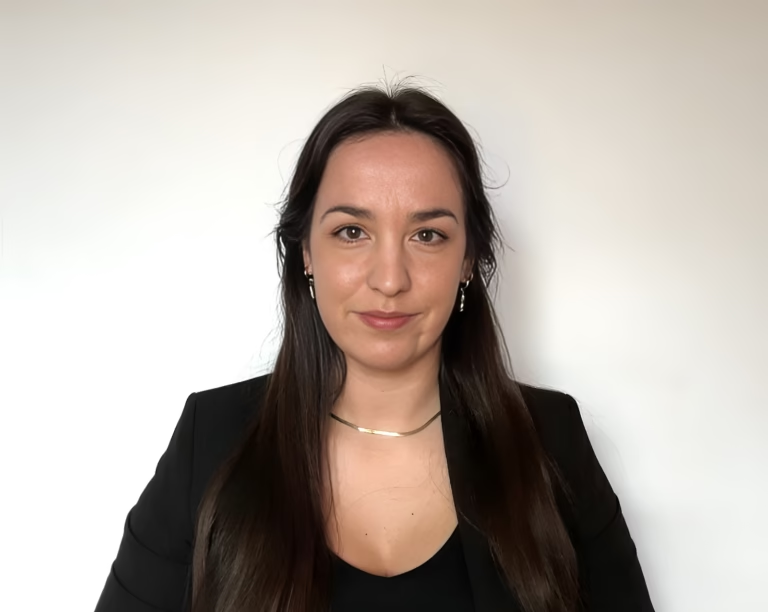
1. Carina, introduce yourself in your own words. Who are you, and what is Impacta Educa?
Off to a great start, then…! Who am I? Honestly, that’s a hard question to answer. I know I’m a mother, I’m autistic, and I live with complex post-traumatic stress, a dissociative disorder, dyscalculia, and ADHD. I’m extroverted, a communicator, sarcastic, and empathetic (perhaps too empathetic). Maybe because I’m so many things at once, I’m someone in constant change. Right now, I’m not the Carina I was when I was still trying to adapt, not the Carina who lived thinking the mask was her own skin, not the Carina I became when I had my son, not the Carina before Impacta Educa, not even the Carina I was last year. And Impacta Educa is the same. A constant, beautiful metamorphosis that adapts, grows, learns, and evolves.
2. Impacta Educa was born of necessity. What failed in the system that made you say, “I have to build this myself”?
My son and I, especially my son, went through some very demanding challenges, and we felt the loneliness. Not just the loneliness of people, but a loneliness with the system, a loneliness in being understood, a loneliness in the happiness of simply being ourselves. I’m aware of our privilege: I’m healthy, I had my family to support me, I managed to place my son in home-schooling, I had the capacity to adapt. But what about those who don’t have these privileges? Is that fair? Is it fair that families, that children and young people, have to suffer for existing? The system failed, above all, in its capacity to listen. For a long time, I felt that the available responses tried to adapt the child to the system, instead of adapting the system to the child. I realised I couldn’t keep only pointing out the gaps. I needed to help build the response I would have wanted to find myself. I promised that, as far as it depended on me, no other family, no other child, would go through what my son and I went through. Impacta Educa was born from exactly that need: to create a space where difference wasn’t just tolerated, but seen for what it truly is, a completely natural way of being in the world, with a value entirely its own.
3. You are neurodivergent yourself, as is part of your team. How has that shaped what Impacta Educa is today (how you work, what you offer, the decisions you make)?
It shaped everything. It influenced how we organise our spaces, how we communicate, how we plan, how we welcome people, and how we make decisions. When we’re neurodivergent, we know from the inside what it feels like to be misread, underestimated, or pushed to function in a way that doesn’t respect our nature. That experience gives us a particular sensitivity to needs that often go unnoticed. At Impacta Educa, we don’t rely only on theory. We work from what we’ve lived ourselves. This changes everything: it creates a genuine environment of empathy, flexibility and honesty. Students and families quickly feel when they’re in a place where they don’t need to keep justifying themselves. We say, “Here, we don’t teach anyone. We create the conditions for the brain to learn.” I believe a neurodivergent team can offer something few others can: genuine understanding, creativity in solving problems, and a deep commitment to building solutions.
4. Impacta Educa has worked on joint projects with IMPACTsci before. How was that experience, and why does it matter for neurodivergent organisations to collaborate?
Working with IMPACTsci felt very natural, because we share core values. There’s a mutual understanding that neurodiversity isn’t a problem to correct, but a human reality that deserves respect and support. When neurodivergent organisations collaborate, they create spaces for new thinking, validation, and collective strength. We stop working in isolation and start building bridges. To me, this is what matters most: it shows that it’s possible to produce science, build services, and change people’s lives from our own lived experience, while holding on to technical rigour and sensitivity.
5. A family considering Impacta Educa has probably already tried other places that didn’t work. What do you say to them?
I ask about the children! Our policy at Impacta Educa is always “nothing about us, without us,” so anyone interested has to come and visit. Feel the environment, understand whether they sense empathy and comfort with the adults there, and above all, whether they feel they can be themselves. Then, to the families themselves, I tell them I believe in them. I believe in the exhaustion, the frustration, and the sense of loneliness that so many carry. I know that feeling, not only as a professional, but as a mother. Many families arrive used to hearing everything their child “can’t do.” Or how their child should already be doing this or that. Or how their child should be in a place “better equipped to handle them.”
Families arrive broken, discouraged, without hope, and exhausted. Children and young people arrive carrying trauma, anxiety, sadness, and shame. Impacta Educa isn’t “just a place.” It’s a safe place.
6. What motivated you to join IMPACTsci’s team of specialists?
It came down to a match in values. I realised IMPACTsci was genuinely committed to science and to respect for neurodivergent people. I felt I could be myself there, without having to separate my personal side from my professional one. When we find people and organisations who speak the same language, collaborating stops being just work and becomes a natural extension of our mission.
7. Have you ever felt that being neurodivergent was used to discredit you?
Too many times. Often, what should be recognised as a source of knowledge and sensitivity gets read instead as weakness or a lack of objectivity. There’s still an idea that someone who lives a particular reality is “too close to it” to speak about it with any authority. I believe the exact opposite. My neurodivergence doesn’t limit me professionally. If anything, it gives me a wider view. I answer with work, consistency and results. Lived experience, combined with technical knowledge, makes for an unbeatable strength.
8. Starting a business is hard enough. Doing it while neurodivergent is a different story. What has been hardest along the way?
Perhaps the hardest part was continuing to believe before there was any outside proof that the vision was possible. The bureaucracy, the constant need to prove our worth, and the struggle for funding are an enormous drain, especially when we already spend half our energy just managing daily life. It was also hard to deal with impostor syndrome and the fear that such a large project might never come together. Right now, the hard part is bearing the pain of what continues to happen. Bearing the pain of seeing so much injustice, so little humanity, so little respect for others, especially when the other person is different from the one causing harm. The hard part is choosing which battles to fight.
9. For anyone who wants to know more about Impacta Educa or get in touch with you, where can they find you?
https://www.instagram.com/impactaeduca/
https://impactaeduca.pt/